
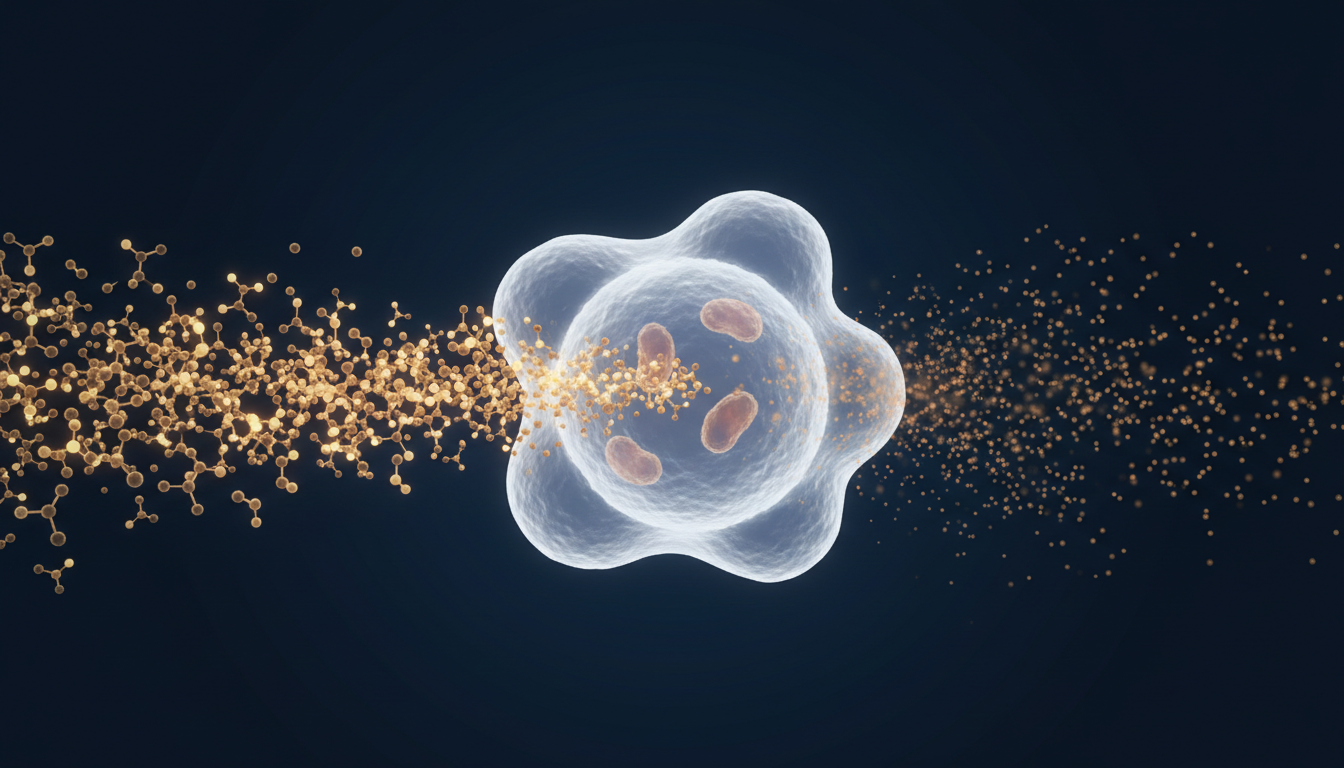
Nearly a hundred years ago, the German physiologist Otto Warburg noticed something strange about cancer. Tumors consumed enormous amounts of glucose and turned most of it into lactic acid, even when plenty of oxygen was available. Normal cells with oxygen burn glucose completely inside their mitochondria. Cancer cells seemed to prefer a fast, wasteful, oxygen-independent route. This pattern, now called the Warburg effect, is one of the most consistent features of cancer, and it shapes everything from how cancer is detected on scans to how diet and drugs are used against it.
What the Warburg Effect Is
Cells can extract energy from glucose in two stages. The first stage, glycolysis, happens in the cell’s fluid and quickly yields a small amount of energy. The second stage, oxidative phosphorylation, happens inside the mitochondria and yields far more, roughly fifteen times as much per glucose molecule. Healthy cells with oxygen use both stages. Cancer cells lean heavily on the first stage alone and dump the leftover as lactate, a pattern called aerobic glycolysis.
Warburg, who received the 1931 Nobel Prize for his work on cellular respiration, believed this happened because cancer cells had damaged mitochondria, and he argued in a famous 1956 paper that this damage was the origin of cancer.1
Why Would a Cancer Cell Choose the Wasteful Route?
Burning glucose halfway seems inefficient, but for a cell trying to divide rapidly it has advantages. Glycolysis is fast. And the partly broken-down glucose provides raw materials, the carbon building blocks for new DNA, proteins and cell membranes that every new cancer cell needs. A widely cited 2009 analysis described the Warburg effect as a way of turning fuel into building materials rather than into maximum energy.2
You Have Already Seen the Warburg Effect: PET Scans
Every FDG-PET scan depends on the Warburg effect. FDG is a radioactive form of glucose. Because cancer cells take up glucose much faster than most normal tissues, they light up on the scan. The SUV number on a PET report is a measure of how avidly a tumor is consuming glucose. Some cancers burn fat or other fuels instead of glucose, which is why they can be faint or invisible on a standard PET scan.
Lactate: How Tumors Use Their Waste as a Shield
The lactic acid that cancer cells pour out does more than acidify their surroundings. Researchers at the University of Regensburg in Germany showed that lactic acid produced by tumors directly suppresses T cells and natural killer cells, the immune cells that destroy cancer. Tumors that produced more lactic acid escaped immune attack more easily.3 This is one reason the Warburg effect matters for immunotherapy.
In 2019, researchers discovered that lactate also attaches directly to the proteins that package DNA, a process called lactylation, switching genes on and off.4 Lactylation has since become one of the most active areas of cancer research, with a large share of the new studies coming from China, and it links the cancer cell’s fuel use directly to its behavior.
The Great Debate: Cause or Consequence?
The metabolic view. Thomas Seyfried of Boston College, building on Warburg, argues that damaged mitochondria come first and the mutations follow, making cancer primarily a metabolic disease. In this view, restricting the fuels cancer cells depend on is a central strategy.5
The mainstream view. Most cancer researchers see the Warburg effect as a consequence of cancer-causing mutations: genes such as MYC and the PI3K–Akt pathway rewire metabolism, and many cancer cells still have working mitochondria. In 2011, “reprogramming energy metabolism” was added to the widely cited list of the hallmarks of cancer.6
For a patient, the practical point is the same either way: the cancer’s fuel use is a measurable weakness. Our book, The New Reality of Cancer, presents both views in detail in its chapter on the metabolic theory of cancer.
Glucose Is Not the Only Fuel
Many cancers also run on glutamine, an amino acid the body makes in its own muscles, so diet alone cannot restrict it. Some cancers run largely on fat. A plan built on the Warburg effect therefore has to consider all three fuels. Blocking glutamine is being studied with drugs, and a June 2026 study from Boston College found that the repurposed drug mebendazole reduced both glucose and glutamine use in brain tumors in mice. Read more in our article on mebendazole and cancer.
What the Warburg Effect Means for Treatment
Lowering glucose and insulin. A ketogenic or low-glycemic diet lowers the glucose supply and the insulin signal that drives cancer growth. Metformin lowers insulin and acts on the cancer cell’s energy production. See our articles on the ketogenic diet and cancer and metformin and cancer.
Drugs that act on glycolysis. In laboratory studies, fenbendazole lowers hexokinase II, the enzyme that takes the first step of glycolysis. See our article on fenbendazole and cancer.
Measuring it. A PET scan shows how hungrily a tumor uses glucose. At home, a glucose and ketone meter shows how far the body’s fuel supply has shifted away from glucose, which is how metabolic therapy is tracked.
Frequently Asked Questions
What is the Warburg effect in simple terms?
It is cancer cells’ habit of burning glucose quickly and incompletely, producing lactic acid even when oxygen is available, instead of burning it fully in their mitochondria.
Does sugar feed cancer?
Cancer cells take up glucose faster than most normal cells, which is why PET scans work. High blood sugar and high insulin are linked to cancer growth, so keeping both low makes biological sense. Glucose is not cancer’s only fuel, however.
Is cancer a metabolic disease?
Scientists disagree. The metabolic theory holds that damaged mitochondria come first; the mainstream view holds that mutations rewire metabolism. Both agree that altered metabolism is a hallmark of cancer.

About the author. Dr. Silver, MD, graduated from Temple University School of Medicine, trained as an interventional cardiologist, and has practiced medicine for nearly fifty years. A lymphoma survivor of about twenty-five years, he is co-author, with Dr. Lindmeier, DHSc, of The New Reality of Cancer: The Science of Recovery. Read more about Dr. Silver, MD.
Research by Dr. Lindmeier, DHSc, cancer educator and co-author of The New Reality of Cancer.
More articles on cancer metabolism and diet and all articles.
References
- Warburg O. On the origin of cancer cells. Science. 1956;123(3191):309–314.
- Vander Heiden MG, Cantley LC, Thompson CB. Understanding the Warburg effect: the metabolic requirements of cell proliferation. Science. 2009;324(5930):1029–1033.
- Brand A, Singer K, Koehl GE, et al. LDHA-associated lactic acid production blunts tumor immunosurveillance by T and NK cells. Cell Metabolism. 2016;24(5):657–671.
- Zhang D, Tang Z, Huang H, et al. Metabolic regulation of gene expression by histone lactylation. Nature. 2019;574(7779):575–580.
- Seyfried TN, Flores RE, Poff AM, D’Agostino DP. Cancer as a metabolic disease: implications for novel therapeutics. Carcinogenesis. 2014;35(3):515–527.
- Hanahan D, Weinberg RA. Hallmarks of cancer: the next generation. Cell. 2011;144(5):646–674.
This article is for education only. It is not medical advice and does not diagnose or treat any condition. Cancer Expert MD has no financial relationship with any laboratory, drug maker, supplement company, clinic or hospital.
Responses
[…] in fat, is one of the most discussed dietary approaches in cancer care. The idea comes from the Warburg effect: many cancers depend heavily on glucose, so lowering the glucose and insulin supply should put them […]
[…] Many solid tumors contain areas with very little oxygen, called hypoxia. Cancer cells starved of oxygen are up to about three times more resistant to radiation, because radiation kills cells largely through oxygen-dependent damage to their DNA. Low oxygen also helps tumors suppress the immune system and resist chemotherapy. See our article on the Warburg effect. […]
[…] When food is withheld, healthy cells slow their growth and switch into a protective, repair-focused state. Cancer cells usually cannot, because the mutations that drive them keep their growth signals switched on. Researchers at the University of Southern California called this differential stress resistance: in their laboratory studies, fasting protected normal cells, but not cancer cells, from high-dose chemotherapy.1 Fasting also lowers blood sugar, insulin and the growth hormone IGF-1, which many cancers depend on. See our article on the Warburg effect. […]