
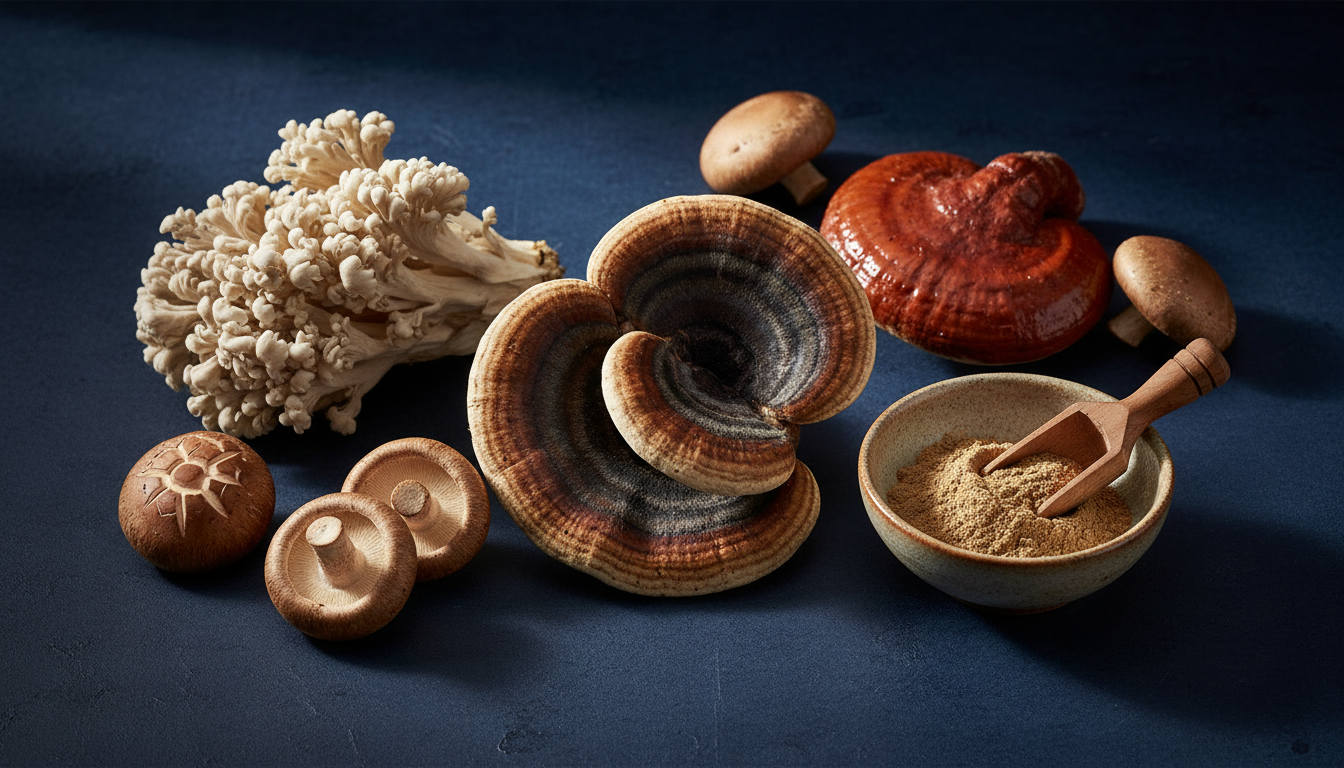
In much of the world, medicinal mushrooms are not an alternative remedy but part of cancer care. In Japan, an extract of the turkey tail mushroom, PSK, was approved as a cancer treatment in 1977 and has been tested in large randomized trials alongside surgery and chemotherapy. In China, mushroom-derived medicines are used in hospitals and have been tested in trials involving more than a thousand patients. This article reviews what those trials show, how mushroom compounds act on the immune system, and what to know about quality and safety.
How Medicinal Mushrooms Work
The best-studied compounds in medicinal mushrooms are beta-glucans, large sugar molecules that the immune system recognizes through receptors on macrophages, natural killer cells and dendritic cells. In effect, they put the immune system on alert. Many mushrooms also contain compounds with direct effects on cancer cells in laboratory studies. In people, the main measurable effects are on immune function, quality of life and, in some trials, survival.
Turkey Tail: PSK in Japan
PSK, also called polysaccharide-K, is extracted from the turkey tail mushroom (Trametes versicolor). It has the strongest evidence of any mushroom extract.
Stomach cancer. A meta-analysis of eight randomized trials in Japan, including 8,009 patients who had surgery for gastric cancer, found that those who received PSK with their chemotherapy lived longer than those who received chemotherapy alone.1
Colorectal cancer. A meta-analysis of three randomized trials, including 1,094 patients who had surgery for colorectal cancer, found that adding PSK to chemotherapy improved both overall survival and disease-free survival.2
Breast cancer. In a phase 1 trial in the United States, women who took turkey tail after radiation for breast cancer showed dose-related recovery of their lymphocyte counts and natural killer cell activity, which radiation had suppressed.3
Shiitake: Lentinan
Lentinan, a beta-glucan from the shiitake mushroom, is used in Japan with chemotherapy for advanced stomach cancer. An analysis of individual patient data from Japanese randomized trials found that adding lentinan to chemotherapy improved survival in advanced or recurrent gastric cancer.4
Huaier: A Chinese Trial in Liver Cancer
Huaier is a medicinal fungus (Trametes robiniophila) used in China. In a multicenter randomized trial of 1,044 patients who had surgery for liver cancer, published in the journal Gut in 2018, those who took Huaier granules had a lower rate of recurrence and better overall survival than those who did not.5 It is one of the largest randomized trials of any natural product in cancer.
Reishi
Reishi (Ganoderma lucidum) has been used in Chinese medicine for two thousand years. A Cochrane review of five randomized trials found that patients who took reishi alongside chemotherapy or radiation were more likely to respond to treatment, had stronger immune markers, and reported better quality of life. The reviewers noted that the trials were small and of limited quality, and that reishi should be used alongside conventional treatment, not instead of it.6
Quality Matters
The trials used specific, standardized extracts. Mushroom supplements on the market vary enormously. Some contain mostly the grain the mushroom was grown on rather than the mushroom itself, and beta-glucan content can range from substantial to almost none. Products that state their beta-glucan content and are tested by an independent laboratory are more likely to resemble what was studied. Laboratories in Europe can also test a patient’s own cancer cells against mushroom extracts. See cancer testing in Germany and Greece.
Safety and Interactions
Blood thinners. Reishi may increase bleeding risk with anticoagulant and antiplatelet drugs, and rare cases of liver injury have been reported with reishi powder.
Kidneys. Chaga is very high in oxalate, and kidney damage has been reported with heavy use.
Skin. Raw or undercooked shiitake can cause a distinctive streaked skin rash.
Immune treatments. Because mushroom extracts stimulate the immune system, their combination with immunotherapy, and their use by people on immune-suppressing drugs after organ transplant, has not been well studied.
Where Mushrooms Fit
The strongest evidence supports specific extracts, PSK, lentinan and Huaier, added to standard treatment in stomach, colorectal and liver cancer, largely from Japanese and Chinese trials. For other cancers the evidence is mainly on immune function and quality of life. Our book, The New Reality of Cancer, has a full chapter on medicinal mushrooms, and our article on integrative treatment for breast cancer reviews other complementary approaches with clinical evidence.
Frequently Asked Questions
Does turkey tail mushroom help with cancer?
Its extract PSK improved survival when added to chemotherapy in Japanese randomized trials in stomach and colorectal cancer, and improved immune recovery after radiation in a breast cancer trial.
Which medicinal mushroom has the strongest evidence?
Turkey tail extract PSK, followed by shiitake extract lentinan and the Chinese fungus Huaier, each tested in randomized trials alongside standard treatment.
Is reishi safe with chemotherapy?
In the trials reviewed by Cochrane it was used alongside chemotherapy and radiation, but it may increase bleeding risk with blood thinners, and rare liver injury has been reported.
Can mushrooms be taken with immunotherapy?
The combination has not been well studied, because both act on the immune system.

About the author. Dr. Silver, MD, graduated from Temple University School of Medicine, trained as an interventional cardiologist, and has practiced medicine for nearly fifty years. A lymphoma survivor of about twenty-five years, he is co-author, with Dr. Lindmeier, DHSc, of The New Reality of Cancer: The Science of Recovery. Read more about Dr. Silver, MD.
Research by Dr. Lindmeier, DHSc, cancer educator and co-author of The New Reality of Cancer.
More articles on integrative cancer treatments and all articles.
References
- Oba K, Teramukai S, Kobayashi M, et al. Efficacy of adjuvant immunochemotherapy with polysaccharide K for patients with curative resections of gastric cancer. Cancer Immunology, Immunotherapy. 2007;56(6):905–911.
- Sakamoto J, Morita S, Oba K, et al. Efficacy of adjuvant immunochemotherapy with polysaccharide K for patients with curatively resected colorectal cancer: a meta-analysis of centrally randomized controlled clinical trials. Cancer Immunology, Immunotherapy. 2006;55(4):404–411.
- Torkelson CJ, Sundberg E, Ellis E, et al. Phase 1 clinical trial of Trametes versicolor in women with breast cancer. ISRN Oncology. 2012;2012:251632.
- Oba K, Kobayashi M, Matsui T, Kodera Y, Sakamoto J. Individual patient based meta-analysis of lentinan for unresectable/recurrent gastric cancer. Anticancer Research. 2009;29(7):2739–2745.
- Chen Q, Shu C, Laurence AD, et al. Effect of Huaier granule on recurrence after curative resection of HCC: a multicentre, randomised clinical trial. Gut. 2018;67(11):2006–2016.
- Jin X, Ruiz Beguerie J, Sze DM, Chan GC. Ganoderma lucidum (Reishi mushroom) for cancer treatment. Cochrane Database of Systematic Reviews. 2016;4:CD007731.
This article is for education only. It is not medical advice and does not diagnose or treat any condition. Cancer Expert MD has no financial relationship with any laboratory, drug maker, supplement company, clinic or hospital.
Responses
[…] Huaier. In a Chinese randomized trial of 1,044 patients after surgery for liver cancer, those who took Huaier, a medicinal mushroom extract, were more likely to remain free of recurrence at 96 weeks, 62 percent compared with 49 percent.11 See our article on medicinal mushrooms. […]
[…] PSK (Krestin). In Japan, PSK, an extract of the turkey tail mushroom, has been used with chemotherapy after stomach cancer surgery for decades, and a meta-analysis of 8,009 patients found improved survival. See our article on medicinal mushrooms. […]