
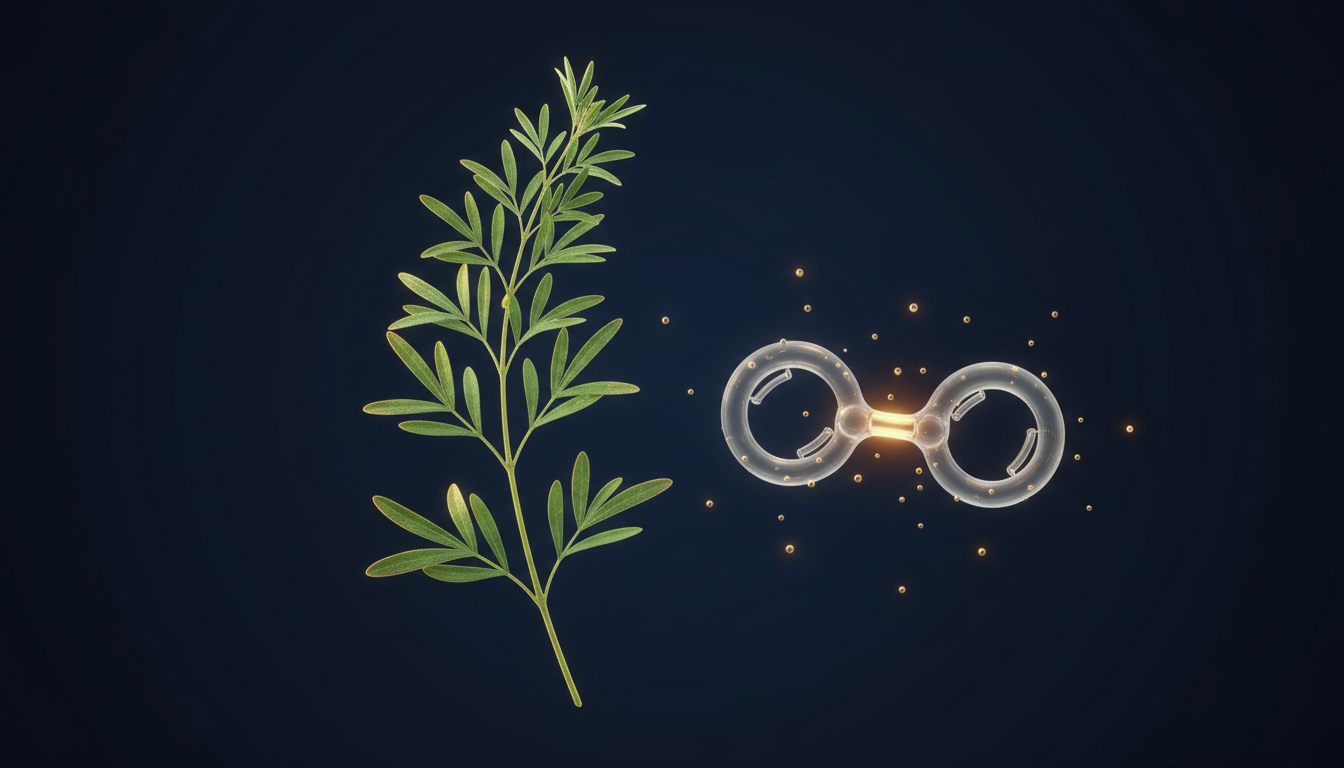
Artemisinin comes from sweet wormwood, Artemisia annua, known in Chinese medicine as Qinghao and used for more than 2,000 years. In the 1970s, the Chinese scientist Tu Youyou isolated artemisinin and showed it cures malaria, work that earned her the Nobel Prize in 2015.1 Artesunate, a water-soluble form of artemisinin, is now on the World Health Organization’s list of essential medicines for malaria, and it is being studied as a repurposed drug against cancer. This article explains how it works, what the human trials show, the doses used, and safety.
How Artemisinin Works Against Cancer
Artemisinin contains a fragile bridge of two oxygen atoms. When it meets iron, the bridge breaks and releases a burst of free radicals that damage the cell. Cancer cells take up far more iron than normal cells to fuel their rapid growth, which makes them especially vulnerable. The German pharmacologist Thomas Efferth, now at the University of Mainz, showed more than 20 years ago that artesunate kills a wide range of cancer cell types in the laboratory, including cells resistant to chemotherapy.2 Artemisinin also triggers an iron-dependent form of cell death called ferroptosis and slows the growth of new blood vessels that feed tumors.
The Human Trials
Colorectal cancer, London. At St George’s, University of London, Sanjeev Krishna’s team randomly assigned 23 patients awaiting surgery for colorectal cancer to oral artesunate, 200 mg a day, or a placebo for two weeks before their operation, without patients or doctors knowing which. Markers of cancer cell growth fell in the artesunate group. After about three and a half years, the cancer had returned in one patient who received artesunate, compared with six who received placebo.3 Because the trial was so small, a larger randomized trial, NeoART, is now under way.4
Metastatic breast cancer, Heidelberg. At the University of Heidelberg Women’s Hospital in Germany, Cornelia von Hagens and colleagues added oral artesunate to standard treatment in 23 women with metastatic breast cancer to find a well-tolerated dose. Up to 200 mg a day was safe and well tolerated, and some patients continued it for more than three years without major safety problems.5
Cervical precancer. Trials of artesunate for precancerous cervical lesions, given orally or as vaginal inserts, are under way.
Artemisinin has not yet been shown in a large randomized trial to extend survival in any cancer.
Doses Used, and Safety
Dose. The British and German studies used oral artesunate up to 200 mg a day. Herbal artemisinin and sweet wormwood products vary widely in content and absorption.
Side effects. At these doses, artesunate is generally well tolerated. At much higher doses, the main limiting effect is a drop in white blood cells. Hearing and balance are monitored in long-term use, and intravenous artesunate given for malaria can occasionally cause a delayed drop in red blood cells.
Interactions. Because artemisinin depends on iron and free radicals, iron supplements may increase its effect, and high-dose antioxidants may weaken it. It is not used in the first three months of pregnancy.
How Cancer Expert MD Helps
Cancer Expert MD provides education and consultation for people with every type and stage of cancer, and specializes in Stage IV and metastatic cancer. Our book, The New Reality of Cancer, covers artemisinin and more than 50 repurposed drugs, with how each works, the pathways it blocks, what studies in people show, the doses used, and drug interactions. See our guide to repurposed drugs and our article on high-dose IV vitamin C, which also works through oxidative damage to cancer cells.
Frequently Asked Questions
What is artesunate?
A water-soluble form of artemisinin, the malaria drug isolated from sweet wormwood by Nobel laureate Tu Youyou. It is being studied as a repurposed drug against cancer.
How does artemisinin kill cancer cells?
It reacts with iron, which cancer cells take up in large amounts, releasing free radicals that damage the cell and trigger an iron-dependent form of cell death.
Has it been tested in people with cancer?
In small trials. In a British trial of 23 patients with colorectal cancer, one patient on artesunate had a recurrence, compared with six on placebo. A larger trial is under way.
Is it safe?
At the doses studied, up to 200 mg a day, it was generally well tolerated, including in women in Heidelberg who took it for more than three years.

About the author. Dr. Silver, MD, graduated from Temple University School of Medicine, trained as an interventional cardiologist, and has practiced medicine for nearly fifty years. A lymphoma survivor of about twenty-five years, he is co-author, with Dr. Lindmeier, DHSc, of The New Reality of Cancer: The Science of Recovery. Read more about Dr. Silver, MD.
Research by Dr. Lindmeier, DHSc, cancer educator and co-author of The New Reality of Cancer.
This article is for general education only and is not individual medical advice. Always consult your own doctor before making any changes to your care.
© 2026 Cancer Expert MD, Dr. Silver, MD, and Dr. Lindmeier, DHSc. All rights reserved. This article draws on the research in The New Reality of Cancer and may not be copied, republished or distributed without written permission.
For more in-depth information on this topic and many others, get our book, The New Reality of Cancer: The Science of Recovery.
More articles on repurposed drugs for cancer and all articles.
References
- Tu Y. The discovery of artemisinin (qinghaosu) and gifts from Chinese medicine. Nature Medicine. 2011;17(10):1217–1220.
- Efferth T, Dunstan H, Sauerbrey A, Miyachi H, Chitambar CR. The anti-malarial artesunate is also active against cancer. International Journal of Oncology. 2001;18(4):767–773.
- Krishna S, Ganapathi S, Ster IC, et al. A randomised, double blind, placebo-controlled pilot study of oral artesunate therapy for colorectal cancer. EBioMedicine. 2015;2(1):82–90.
- Phase II randomised, double-blind, placebo-controlled trial of neoadjuvant artesunate in stage II/III colorectal cancer (NeoART-M), protocol version 6.0. 2024. ClinicalTrials.gov NCT07095309.
- von Hagens C, Walter-Sack I, Goeckenjan M, et al. Prospective open uncontrolled phase I study to define a well-tolerated dose of oral artesunate as add-on therapy in patients with metastatic breast cancer (ARTIC M33/2). Breast Cancer Research and Treatment. 2017;164(2):359–369.
This article is for education only. It is not medical advice and does not diagnose or treat any condition. Cancer Expert MD has no financial relationship with any laboratory, drug maker, supplement company, clinic or hospital.
Leave a Reply