
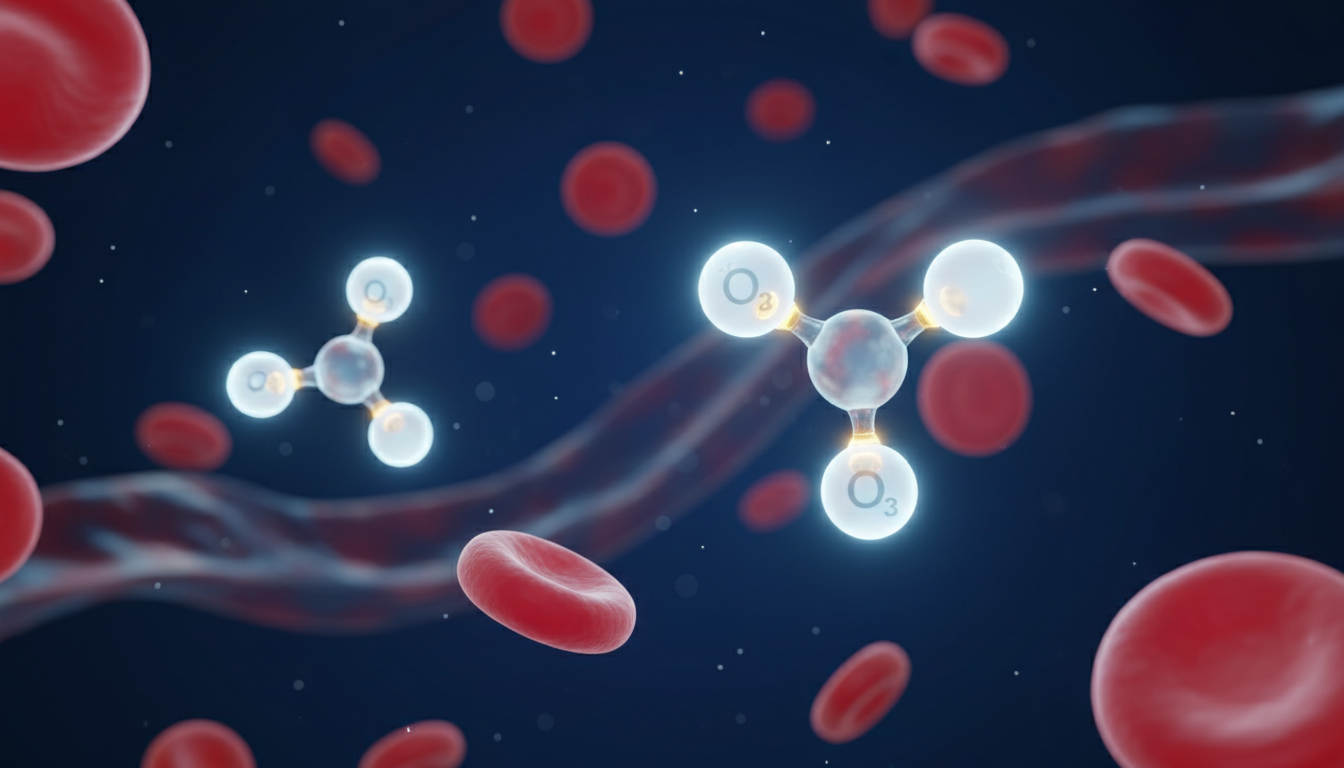
Ozone is a molecule made of three oxygen atoms. Medical ozone is a precise mixture of a small amount of ozone in pure oxygen, prepared by a medical generator. It has been used for decades in Germany, Italy, Spain, Russia and Cuba, and Dr. Silver, MD, trained in ozone therapy. This article explains how it works, how it is given, what clinical studies show in people with cancer, and how to use it safely.
How Ozone Therapy Works
Ozone is not given to kill cancer cells directly inside the body. In small, controlled doses, it causes a brief, mild oxidative stress, and the body answers by switching on its own antioxidant and repair defenses, improving oxygen delivery to tissues and adjusting the immune response. The Italian physiologist Velio Bocci described this as a hormetic effect: a small, measured stress that makes the body stronger.1 The dose matters. Too little does nothing, and too much causes harm.
How It Is Given
Major autohemotherapy. A measured amount of the patient’s own blood is drawn, mixed with medical ozone and oxygen, and returned through the vein.
Rectal insufflation. The ozone and oxygen mixture is introduced through a thin tube, where it is absorbed through the bowel wall.
Local treatment. Ozone gas, ozonated water or ozonated oil is applied directly to wounds, damaged tissue, the bladder or rectum, or injected into tissue.
Dentistry. Biological dentists use ozone gas, water and oil to disinfect infected teeth, root canals and jaw cavitations, areas of chronic infection that are discussed in our book.
What the Research Shows in Cancer Care
The most careful clinical work on ozone in people with cancer comes from Spain, where Bernardino Clavo and colleagues at the Dr. Negrín University Hospital in Gran Canaria have studied it for more than two decades.2
Radiation damage. Radiation to the pelvis can cause bleeding from the rectum or bladder and chronic pelvic pain years later. In patients whose bleeding had not responded to other treatments, ozone applied to the rectum or bladder gave long-lasting control.3 These studies were small, and none had a comparison group.
Nerve damage from chemotherapy. Drugs such as oxaliplatin and paclitaxel can leave lasting numbness, tingling and pain in the hands and feet, with few effective treatments. In a 2025 Spanish study of patients with persistent numbness and tingling, 67 percent reported that their symptoms fell by at least half after ozone treatment, and 47 percent improved by at least one grade of severity.4 Because that study looked back at treated patients, the same team is now running a randomized, triple-blind trial against a placebo, called OzoParQT.5
Jaw bone damage from bone-strengthening drugs. Zoledronic acid and denosumab, used for cancer that has spread to bone, can cause areas of dead jaw bone that will not heal. In Milan, Carla Ripamonti’s team treated these lesions with ozonated oil in a phase 1–2 study,6 and in a 2024 study of 29 patients treated with ozone injections before surgery, the lesions healed completely in 79 percent.7
Oxygen in tumors. Tumors with low oxygen resist radiation. In a Spanish pilot study, ozone treatment raised oxygen levels in the most poorly oxygenated head and neck tumors.8 See our article on hyperbaric oxygen therapy, which works on the same problem in a different way.
Survival. No randomized trial has yet shown that ozone therapy extends survival in cancer. Its best evidence is in relieving the lasting side effects of radiation and chemotherapy.
Safety
Given properly, serious problems are rare. A large German survey of ozone treatments found that serious complications were very uncommon and that most came from injecting ozone gas directly into a vein, a method that should never be used.9
Never breathe ozone. Inhaled ozone damages the lungs. The U.S. Food and Drug Administration classifies ozone as a toxic gas and does not recognize a medical use for it,10 while Germany, Italy and Spain regulate ozone therapy as a medical procedure.
Who should not have it. People with G6PD deficiency, an inherited condition in which oxidative stress can break down red blood cells, should not receive ozone. It is also avoided in pregnancy, uncontrolled overactive thyroid, severe anemia, very low platelet counts and after a recent heart attack, and blood thinners require care with autohemotherapy.
Timing. Because ozone changes the body’s oxidative balance, its timing in relation to chemotherapy and radiation should be planned carefully.
How Cancer Expert MD Helps
Cancer Expert MD provides education and consultation for people with every type and stage of cancer, and specializes in Stage IV and metastatic cancer. Our guide to what to do when chemotherapy stops working explains re-testing and the next steps, and our book, The New Reality of Cancer, covers oxygen, ozone and the other integrative therapies in depth. See also high-dose IV vitamin C and hyperthermia.
Frequently Asked Questions
Does ozone therapy cure cancer?
No study has shown that. Its best evidence is in relieving lasting side effects of cancer treatment, such as radiation damage, chemotherapy nerve damage and jaw bone damage.
Is ozone therapy safe?
Given properly, serious complications are rare. Ozone must never be inhaled or injected as a gas into a vein, and it is not used in people with G6PD deficiency.
Can ozone help numbness and tingling from chemotherapy?
In a 2025 Spanish study, two-thirds of patients reported their numbness and tingling fell by at least half after ozone treatment. A randomized, placebo-controlled trial is now under way to confirm it.
How is ozone therapy given?
Most often by mixing a measured amount of the patient’s blood with medical ozone and returning it through the vein, by rectal insufflation, or by applying ozone gas, water or oil directly to the affected area.

About the author. Dr. Silver, MD, graduated from Temple University School of Medicine, trained as an interventional cardiologist, and has practiced medicine for nearly fifty years. A lymphoma survivor of about twenty-five years, he is co-author, with Dr. Lindmeier, DHSc, of The New Reality of Cancer: The Science of Recovery. Read more about Dr. Silver, MD.
Research by Dr. Lindmeier, DHSc, cancer educator and co-author of The New Reality of Cancer.
This article is for general education only and is not individual medical advice. Always consult your own doctor before making any changes to your care.
© 2026 Cancer Expert MD, Dr. Silver, MD, and Dr. Lindmeier, DHSc. All rights reserved. This article draws on the research in The New Reality of Cancer and may not be copied, republished or distributed without written permission.
For more in-depth information on this topic and many others, get our book, The New Reality of Cancer: The Science of Recovery.
More articles on integrative cancer treatments and all articles.
References
- Bocci V, Zanardi I, Travagli V. Ozone acting on human blood yields a hormetic dose-response relationship. Journal of Translational Medicine. 2011;9:66.
- Clavo B, et al. Ozone therapy as adjuvant for cancer treatment: is further research warranted? Evidence-Based Complementary and Alternative Medicine. 2018.
- Clavo B, et al. Long-term control of refractory hemorrhagic radiation proctitis with ozone therapy. Journal of Pain and Symptom Management. 2013.
- Clavo B, Rodríguez-Abreu D, Galván-Ruiz S, et al. Long-term effects of ozone treatment in patients with persistent numbness and tingling secondary to chemotherapy-induced peripheral neuropathy: a retrospective study. Integrative Cancer Therapies. 2025.
- Clavo B, et al. Effectiveness and cost-effectiveness of ozone treatment in patients with paraesthesia secondary to chemotherapy-induced peripheral neuropathy: randomized, triple-blind clinical trial (OzoParQT), study protocol.
- Ripamonti CI, Cislaghi E, Mariani L, Maniezzo M. Efficacy and safety of medical ozone delivered in oil suspension applications for the treatment of osteonecrosis of the jaw in patients with bone metastases treated with bisphosphonates: preliminary results of a phase I–II study. Oral Oncology. 2011.
- Pre-operative ozone infiltration therapy in patients with medication-related osteonecrosis of the jaws: a prospective clinical study. Oral and Maxillofacial Surgery. 2024.
- Clavo B, Pérez JL, López L, et al. Ozone therapy for tumor oxygenation: a pilot study. Evidence-Based Complementary and Alternative Medicine. 2004;1(1):93–98.
- Jacobs MT. Adverse effects and typical complications in ozone-oxygen therapy. OzoNachrichten. 1982;1:5.
- U.S. Food and Drug Administration. Maximum acceptable level of ozone. Code of Federal Regulations, 21 CFR 801.415.
This article is for education only. It is not medical advice and does not diagnose or treat any condition. Cancer Expert MD has no financial relationship with any laboratory, drug maker, supplement company, clinic or hospital.
Leave a Reply