
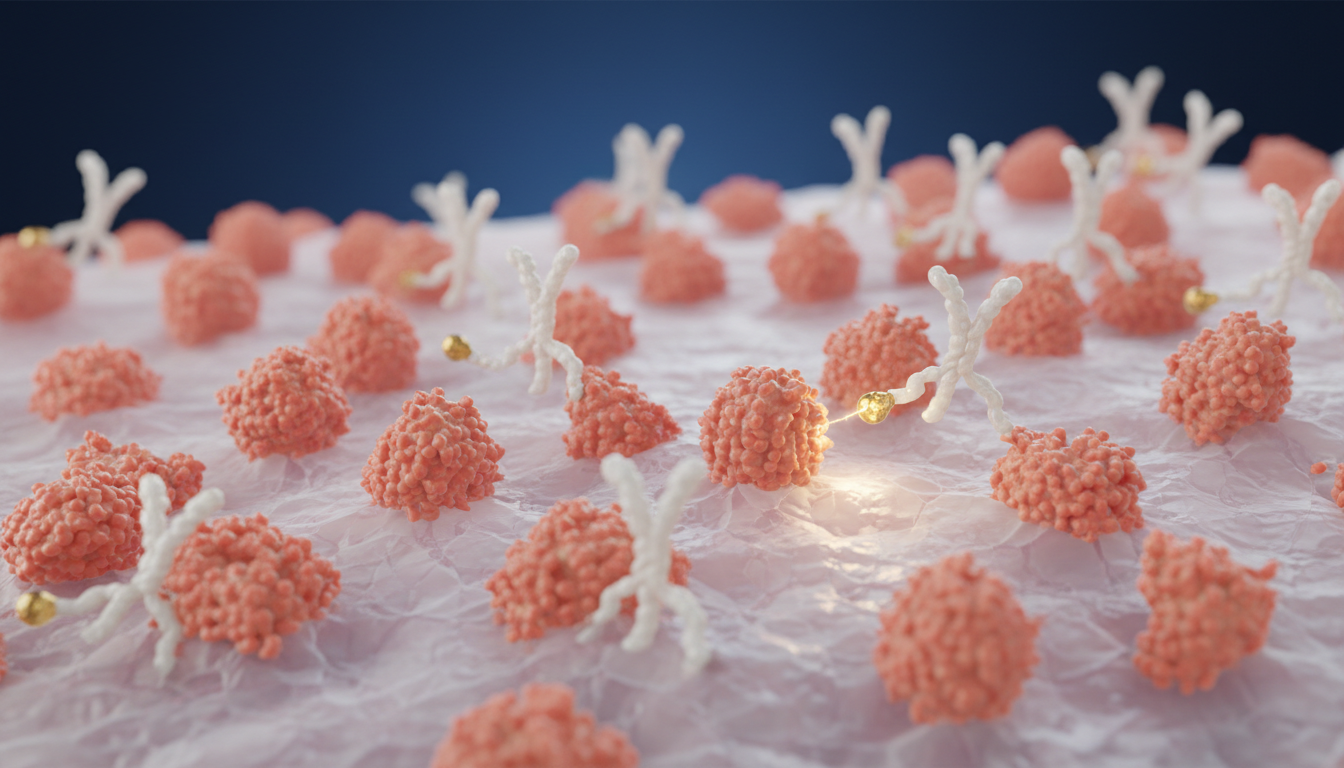
About 15 to 20 percent of breast cancers are HER2-positive: their cells carry many extra copies of a growth receptor called HER2, which drives fast, aggressive growth. Before the late 1990s, HER2-positive breast cancer had one of the worst outlooks of any type. Today, thanks to drugs that target HER2 directly, it is one of the most treatable, and 2025 brought another major step forward. This article explains how HER2-positive breast cancer is treated and what the newest trials show.
Early-Stage Disease
Treatment before surgery. Most women with HER2-positive tumors larger than a small size, or with involved lymph nodes, receive chemotherapy combined with two HER2 antibodies, trastuzumab and pertuzumab, before surgery. How the tumor responds guides what comes next.
When cancer remains at surgery. In the KATHERINE trial, led by the German Breast Group, women who still had cancer at surgery were switched to the antibody-drug conjugate trastuzumab emtansine, which carries chemotherapy directly into HER2-positive cells. It cut the risk of recurrence by about half compared with continuing trastuzumab.1
A stronger start (2025). In the DESTINY-Breast11 trial, published in Annals of Oncology in 2025, women with high-risk HER2-positive early breast cancer received the newer antibody-drug conjugate trastuzumab deruxtecan before surgery, followed by standard treatment. Two-thirds of them, 67.3 percent, had no remaining invasive cancer at surgery, a higher rate than standard treatment achieved.2
Metastatic Disease: A New First-Line Standard
For more than a decade, the standard first treatment for metastatic HER2-positive breast cancer was a taxane chemotherapy with trastuzumab and pertuzumab, established by the CLEOPATRA trial, which extended median survival by more than a year.3
In 2025, the DESTINY-Breast09 trial changed that. Replacing the chemotherapy and trastuzumab with trastuzumab deruxtecan, combined with pertuzumab, extended median progression-free survival to 40.7 months, compared with 26.9 months with the standard regimen, a 44 percent reduction in the risk of progression or death. Nearly twice as many patients had no visible disease on imaging.4 It was the first trial in more than a decade to improve first-line treatment for a broad group of patients with this disease.
A Chinese alternative. In China, the oral HER2-blocking drug pyrotinib is widely used. In the Chinese PHILA trial, adding pyrotinib to trastuzumab and docetaxel as first-line treatment significantly improved progression-free survival compared with placebo.5
Later lines and brain metastases
After first-line treatment, trastuzumab deruxtecan proved far more effective than trastuzumab emtansine in the DESTINY-Breast03 trial.6 HER2-positive breast cancer spreads to the brain more often than other types. In the HER2CLIMB trial, adding the oral drug tucatinib to trastuzumab and capecitabine extended survival, including in women with brain metastases.7 Trastuzumab deruxtecan also shrinks brain metastases in many patients.
Protecting the Heart and Lungs
The heart. Trastuzumab can weaken the heart muscle, especially when combined with anthracycline chemotherapy. Heart function is checked with an echocardiogram or similar scan before and at regular intervals during treatment. The weakening is usually reversible if caught early, which is exactly why the monitoring matters.
The lungs. Trastuzumab deruxtecan can cause interstitial lung disease, an inflammation of the lungs that can become serious. New cough, shortness of breath or fever during treatment should be reported immediately so that it can be caught early.
Testing and Monitoring
HER2 status can change between the original tumor and metastases, so a biopsy of a metastasis, when possible, confirms the target. Blood tests add a further view: in the German DETECT III trial, HER2 found on circulating tumor cells guided successful HER2-targeted treatment even when the original tumor was HER2-negative. See our articles on circulating tumor cell testing and tumor sequencing.
Coming Soon: The New Reality of Breast Cancer
Cancer Expert MD specializes in education and consultation for people with Stage IV and metastatic cancer. Our companion book, The New Reality of Breast Cancer: The Science of Recovery, is coming soon. Learn more on our book page, and read our articles on hormone receptor-positive breast cancer, triple-negative breast cancer, stage 4 breast cancer and integrative treatment for breast cancer.
Frequently Asked Questions
What is HER2-positive breast cancer?
Breast cancer whose cells carry many extra copies of the HER2 growth receptor. It accounts for about 15 to 20 percent of breast cancers and is treated with drugs that target HER2 directly.
What is the newest first-line treatment for metastatic HER2-positive breast cancer?
Trastuzumab deruxtecan combined with pertuzumab, which extended median progression-free survival to 40.7 months in the 2025 DESTINY-Breast09 trial.
Can HER2-positive breast cancer spread to the brain?
It does so more often than other types. Tucatinib and trastuzumab deruxtecan are both active against brain metastases.
Does HER2 treatment affect the heart?
Trastuzumab can weaken the heart muscle, usually reversibly, so heart function is checked before and during treatment.

About the author. Dr. Silver, MD, graduated from Temple University School of Medicine, trained as an interventional cardiologist, and has practiced medicine for nearly fifty years. A lymphoma survivor of about twenty-five years, he is co-author, with Dr. Lindmeier, DHSc, of The New Reality of Cancer: The Science of Recovery. Read more about Dr. Silver, MD.
Research by Dr. Lindmeier, DHSc, cancer educator and co-author of The New Reality of Cancer.
More articles on breast cancer and all articles.
References
- von Minckwitz G, Huang CS, Mano MS, et al. Trastuzumab emtansine for residual invasive HER2-positive breast cancer (KATHERINE). New England Journal of Medicine. 2019;380(7):617–628.
- Neoadjuvant trastuzumab deruxtecan alone or followed by paclitaxel, trastuzumab, and pertuzumab for high-risk HER2-positive early breast cancer (DESTINY-Breast11): a randomised, open-label, multicentre, phase III trial. Annals of Oncology. 2025.
- Swain SM, Baselga J, Kim SB, et al. Pertuzumab, trastuzumab, and docetaxel in HER2-positive metastatic breast cancer (CLEOPATRA). New England Journal of Medicine. 2015;372(8):724–734.
- Tolaney SM, et al. Trastuzumab deruxtecan plus pertuzumab versus taxane, trastuzumab and pertuzumab as first-line treatment for HER2-positive metastatic breast cancer (DESTINY-Breast09). New England Journal of Medicine. 2026; first presented at the ASCO Annual Meeting 2025.
- Ma F, Yan M, Li W, et al. Pyrotinib versus placebo in combination with trastuzumab and docetaxel as first-line treatment in patients with HER2-positive metastatic breast cancer (PHILA): randomised, double-blind, multicentre, phase 3 trial. BMJ. 2023;383:e076065.
- Cortés J, Kim SB, Chung WP, et al. Trastuzumab deruxtecan versus trastuzumab emtansine for breast cancer (DESTINY-Breast03). New England Journal of Medicine. 2022;386(12):1143–1154.
- Murthy RK, Loi S, Okines A, et al. Tucatinib, trastuzumab, and capecitabine for HER2-positive metastatic breast cancer (HER2CLIMB). New England Journal of Medicine. 2020;382(7):597–609.
This article is for education only. It is not medical advice and does not diagnose or treat any condition. Cancer Expert MD has no financial relationship with any laboratory, drug maker, supplement company, clinic or hospital.
Response
[…] The Science of Recovery, is coming soon. Learn more on our book page, and read our articles on HER2-positive breast cancer, triple-negative breast cancer and stage 4 breast […]