
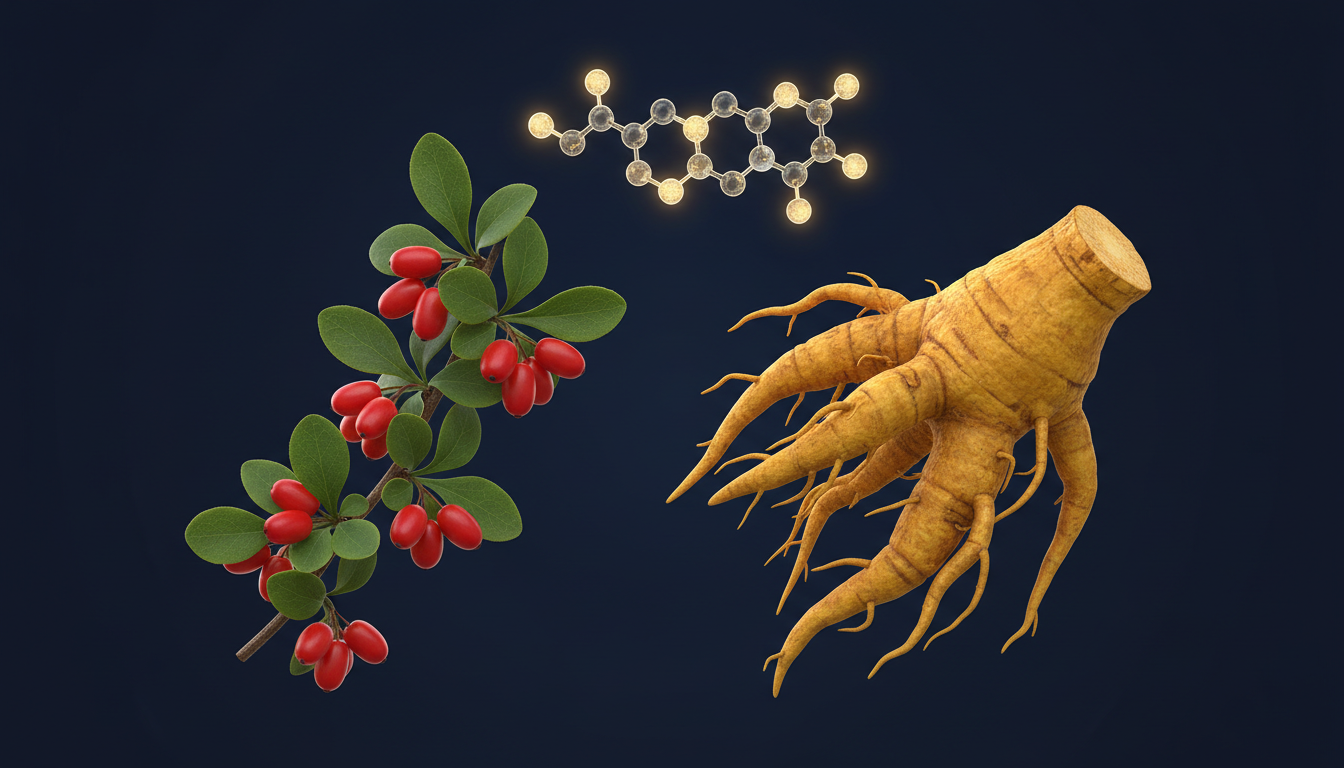
Berberine is a bright yellow compound found in several plants, including goldenseal, barberry and the Chinese herb Coptis chinensis, known as Huanglian. It has been used for centuries in Chinese and Ayurvedic medicine, mainly for diarrhea and infections, and today is sold widely as a supplement for blood sugar and cholesterol. It also has one of the strongest human trials of any natural compound in cancer prevention. This article explains how berberine works, what the trials show, the doses used, and its drug interactions.
How Berberine Works
Berberine switches on AMPK, the same energy sensor that metformin activates, which lowers blood sugar and insulin and slows the growth signals many cancers depend on. It also reduces inflammation and reshapes the gut bacteria, and Shanghai researchers have found that it reduces bacteria linked to colon cancer development. See our article on metformin and cancer.
The Shanghai Trial: Preventing Colon Polyps
Most colon cancers begin as polyps called adenomas, and in many people new ones keep forming after polyps are removed. In the CBAR trial, led by Jing-Yuan Fang of Shanghai Jiao Tong University at seven hospitals in six Chinese provinces, more than 1,100 people who had polyps removed were randomly assigned to berberine, 300 mg twice a day, or a placebo, for two years, without patients or doctors knowing which. New adenomas developed in 36 percent of the berberine group, compared with 47 percent of the placebo group, and advanced adenomas, the type most likely to become cancer, in 3 percent compared with 6 percent. There were no serious side effects.1
Six years later. The same team followed 781 of the participants for six years after they stopped taking berberine. The protection lasted: adenomas returned in 34.7 percent of the berberine group, compared with 52.1 percent of the placebo group.2
Now in colon cancer. A new Chinese randomized, double-blind trial, launched in 2026, is testing whether berberine prevents recurrence after surgery for stage III colon cancer.3 See our article on colon cancer treatment.
Other Cancers
In laboratory studies, berberine slows the growth of many cancer types, including breast, liver, lung and stomach cancer, and makes some cancer cells more sensitive to chemotherapy. These effects have not yet been tested in clinical trials in people with those cancers.
Doses Used, and Safety
Dose. The Shanghai trial used 300 mg twice a day.
Side effects. The most common are constipation and stomach upset, which go away when it is stopped.
Drug interactions. Berberine slows several liver enzymes and drug transporters that clear medicines from the body, so it can raise blood levels of many drugs, including some chemotherapy and targeted cancer drugs and the transplant drugs cyclosporine and tacrolimus. It adds to the effect of diabetes medicines, including metformin and insulin, and can cause low blood sugar. Its use alongside cancer drugs should be checked drug by drug.
Who should not take it. Berberine is not used in pregnancy or while breastfeeding, because it can worsen jaundice in newborns.
How Cancer Expert MD Helps
Cancer Expert MD provides education and consultation for people with every type and stage of cancer, and specializes in Stage IV and metastatic cancer. Our book, The New Reality of Cancer, covers berberine and the other vitamins, minerals, plant compounds, herbs and mushrooms studied against cancer, with how each works, the pathways it blocks, what studies in people show, the doses used, and drug interactions. See also our guide to repurposed drugs and our article on curcumin.
Frequently Asked Questions
Does berberine prevent colon cancer?
In a Shanghai trial of more than 1,100 people, berberine reduced the return of precancerous colon polyps, and the protection lasted six years after stopping. A trial in people treated for colon cancer began in 2026.
How does berberine compare with metformin?
Both activate the energy sensor AMPK and lower blood sugar and insulin. Taking them together adds to the blood-sugar-lowering effect.
What dose was used in the trial?
300 mg twice a day for two years.
Can berberine interfere with cancer treatment?
It can raise blood levels of many medicines, including some cancer drugs, so its use alongside treatment should be checked drug by drug.

About the author. Dr. Silver, MD, graduated from Temple University School of Medicine, trained as an interventional cardiologist, and has practiced medicine for nearly fifty years. A lymphoma survivor of about twenty-five years, he is co-author, with Dr. Lindmeier, DHSc, of The New Reality of Cancer: The Science of Recovery. Read more about Dr. Silver, MD.
Research by Dr. Lindmeier, DHSc, cancer educator and co-author of The New Reality of Cancer.
This article is for general education only and is not individual medical advice. Always consult your own doctor before making any changes to your care.
© 2026 Lovely LYF LLC. All rights reserved. This article draws on the research in The New Reality of Cancer and may not be copied, republished or distributed without written permission.
For more in-depth information on this topic and many others, get our book, The New Reality of Cancer: The Science of Recovery.
More articles on integrative cancer treatments and all articles.
References
- Chen YX, Gao QY, Zou TH, et al. Berberine versus placebo for the prevention of recurrence of colorectal adenoma: a multicentre, double-blinded, randomised controlled study. The Lancet Gastroenterology & Hepatology. 2020;5(3):267–275.
- Berberine for preventing colorectal adenoma recurrence and neoplasm occurrence: 6-year follow-up of a randomized clinical trial. Cell Reports Medicine. 2025;6(9):102293.
- Li Y, Zhang L, Tong H, et al. Berberine prevents postoperative recurrence of colorectal cancer: a protocol for a multicenter, double-blind, randomized controlled trial. Frontiers in Medicine. 2026.
This article is for education only. It is not medical advice and does not diagnose or treat any condition. Cancer Expert MD has no financial relationship with any laboratory, drug maker, supplement company, clinic or hospital.
Leave a Reply