
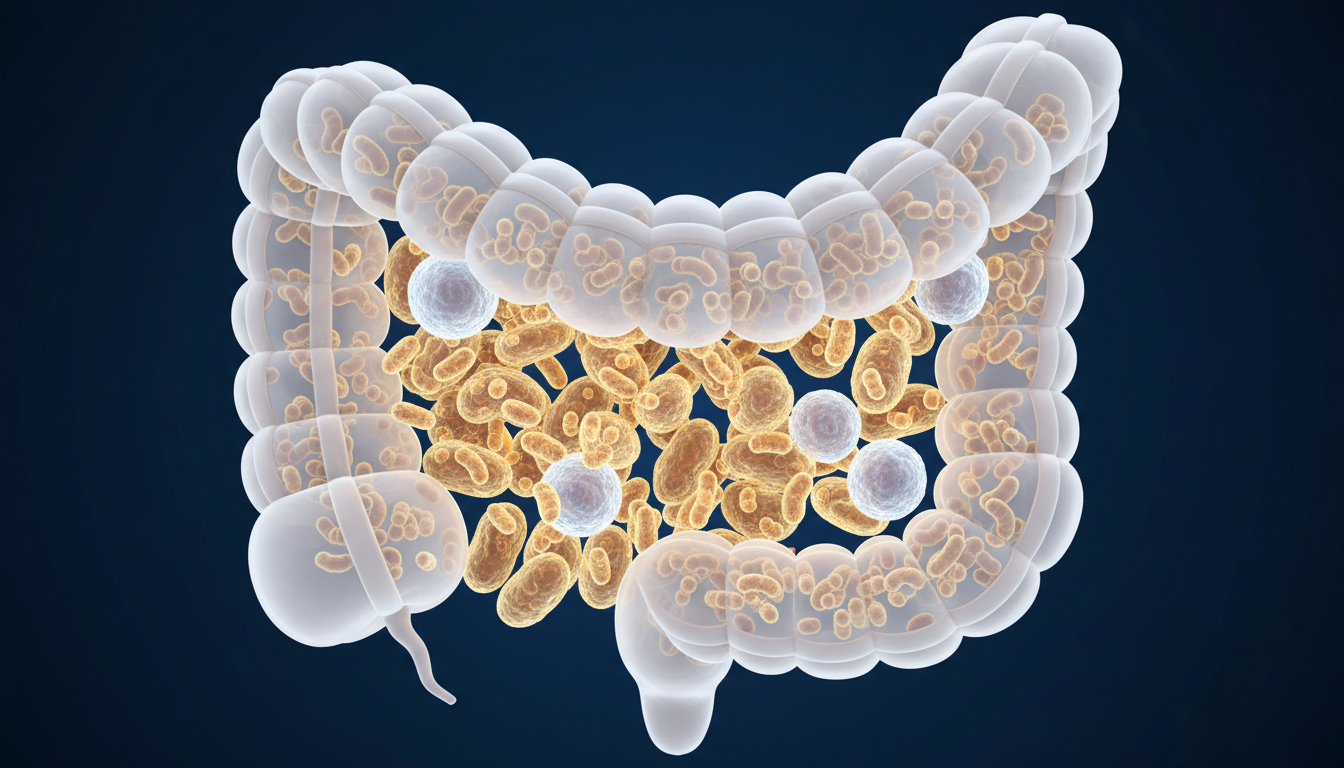
The human gut holds trillions of bacteria, together called the gut microbiome. They do far more than digest food. They train the immune system, and research over the past decade has shown that they help decide whether immunotherapy and some chemotherapy drugs work. This makes the microbiome one of the few parts of cancer treatment that patients can influence themselves, through diet and careful use of antibiotics. This article explains the research.
Gut Bacteria and Immunotherapy: The French Discovery
At Gustave Roussy in Paris, researchers led by Laurence Zitvogel found that people who took antibiotics shortly before or after starting immunotherapy lived shorter lives than those who did not, and that patients whose gut contained a bacterium called Akkermansia muciniphila responded better. When they transferred gut bacteria from patients who responded into mice, the mice responded to immunotherapy too.1 Antibiotics are sometimes essential, but unnecessary courses around immunotherapy are worth avoiding. See our article on how immunotherapy works.
Gut Microbiome Transplants
Israel. At Sheba Medical Center, people with melanoma that had stopped responding to immunotherapy received a transplant of gut bacteria from patients who had responded. In some, the melanoma began responding again.2
Canada. In Montreal, people with advanced melanoma received gut bacteria from healthy donors along with their first immunotherapy, and tumors shrank in 65 percent, a higher rate than expected with immunotherapy alone.3
Italy. In the Italian TACITO trial in kidney cancer, a gut bacteria transplant with immunotherapy improved the time before the cancer grew. See our article on kidney cancer.
Fiber Versus Probiotic Pills
In a study of melanoma patients at MD Anderson Cancer Center, those who ate enough dietary fiber lived longer without progression on immunotherapy, while those who took over-the-counter probiotic supplements did not benefit and tended to have a less diverse gut microbiome.4 Researchers at the Weizmann Institute in Israel found that taking probiotic pills after a course of antibiotics actually delayed the return of the body’s own healthy gut bacteria.5 Specific, well-studied probiotic strains can help in particular situations, but more is not always better.
Gut Bacteria and Chemotherapy
Gustave Roussy researchers also showed in laboratory research that the chemotherapy drug cyclophosphamide relies on gut bacteria to stimulate the immune response against cancer.6 Some bacteria work against patients: Fusobacterium nucleatum, a mouth bacterium, is found inside many colorectal cancers and has been linked to chemotherapy resistance. See our article on dental infections and cancer.
Integrative Research on the Gut Microbiome
Dietary fiber. Fiber from vegetables, legumes and whole grains feeds the beneficial bacteria that support the immune system. In the MD Anderson study, melanoma patients who ate at least 20 grams of fiber a day went longer without their cancer progressing on immunotherapy (Spencer and colleagues, Science, 2021).
A Japanese probiotic. CBM588, a strain of Clostridium butyricum developed and widely used in Japan, is one of the few probiotics tested in randomized cancer trials. Added to immunotherapy in metastatic kidney cancer, it extended the time before the cancer grew in two small randomized trials (Dizman and colleagues, Nature Medicine, 2022; Ebrahimi and colleagues, Nature Medicine, 2024).
These are some of the natural and integrative options studied for the gut microbiome in cancer, and others have promising research as well. Which may fit your situation depends on your type of cancer, your current treatment and possible drug interactions. In a consultation, Dr. Silver, MD, educates you on these options and the research behind them. Request a consultation.
How Cancer Expert MD Helps
Cancer Expert MD provides education and consultation for people with every type and stage of cancer, and specializes in Stage IV and metastatic cancer. Our book, The New Reality of Cancer, covers the terrain in which cancer grows, including the gut microbiome, nutrition and the natural compounds studied in cancer. See also our articles on the tumor microenvironment and preparing for a biopsy or cancer surgery.
Frequently Asked Questions
Do gut bacteria affect cancer treatment?
Yes. Research from France, Israel, Canada and Italy shows that gut bacteria help decide whether immunotherapy works, and some chemotherapy drugs depend on them too.
Should I avoid antibiotics during immunotherapy?
Antibiotics are sometimes essential, but people who took them shortly before or after starting immunotherapy had worse results, so unnecessary courses are worth avoiding.
Should I take probiotics during cancer treatment?
Not automatically. In an MD Anderson study, over-the-counter probiotics did not help melanoma patients on immunotherapy, while dietary fiber did. A few specific strains, such as the Japanese probiotic CBM588, have been tested in cancer trials.
What is a gut microbiome transplant?
A transfer of gut bacteria from a carefully screened donor. In trials in Israel, Canada and Italy, it helped immunotherapy work better in some patients.

About the author. Dr. Silver, MD, graduated from Temple University School of Medicine, trained as an interventional cardiologist, and has practiced medicine for nearly fifty years. A lymphoma survivor of about twenty-five years, he is co-author, with Dr. Lindmeier, DHSc, of The New Reality of Cancer: The Science of Recovery. Read more about Dr. Silver, MD.
Research by Dr. Lindmeier, DHSc, cancer educator and co-author of The New Reality of Cancer.
This article is for general education only and is not individual medical advice. Always consult your own doctor before making any changes to your care.
© 2026 Lovely LYF LLC. All rights reserved. This article draws on the research in The New Reality of Cancer and may not be copied, republished or distributed without written permission.
For more in-depth information on this topic and many others, get our book, The New Reality of Cancer: The Science of Recovery.
More articles on integrative cancer treatments and all articles.
References
- Routy B, Le Chatelier E, Derosa L, et al. Gut microbiome influences efficacy of PD-1–based immunotherapy against epithelial tumors. Science. 2018;359(6371):91–97.
- Baruch EN, Youngster I, Ben-Betzalel G, et al. Fecal microbiota transplant promotes response in immunotherapy-refractory melanoma patients. Science. 2021;371(6529):602–609.
- Routy B, Lenehan JG, Miller WH Jr, et al. Fecal microbiota transplantation plus anti-PD-1 immunotherapy in advanced melanoma: a phase I trial. Nature Medicine. 2023;29(8):2121–2132.
- Spencer CN, McQuade JL, Gopalakrishnan V, et al. Dietary fiber and probiotics influence the gut microbiome and melanoma immunotherapy response. Science. 2021;374(6575):1632–1640.
- Suez J, Zmora N, Zilberman-Schapira G, et al. Post-antibiotic gut mucosal microbiome reconstitution is impaired by probiotics and improved by autologous FMT. Cell. 2018;174(6):1406–1423.
- Viaud S, Saccheri F, Mignot G, et al. The intestinal microbiota modulates the anticancer immune effects of cyclophosphamide. Science. 2013;342(6161):971–976.
This article is for education only. It is not medical advice and does not diagnose or treat any condition. Cancer Expert MD has no financial relationship with any laboratory, drug maker, supplement company, clinic or hospital.
Leave a Reply