
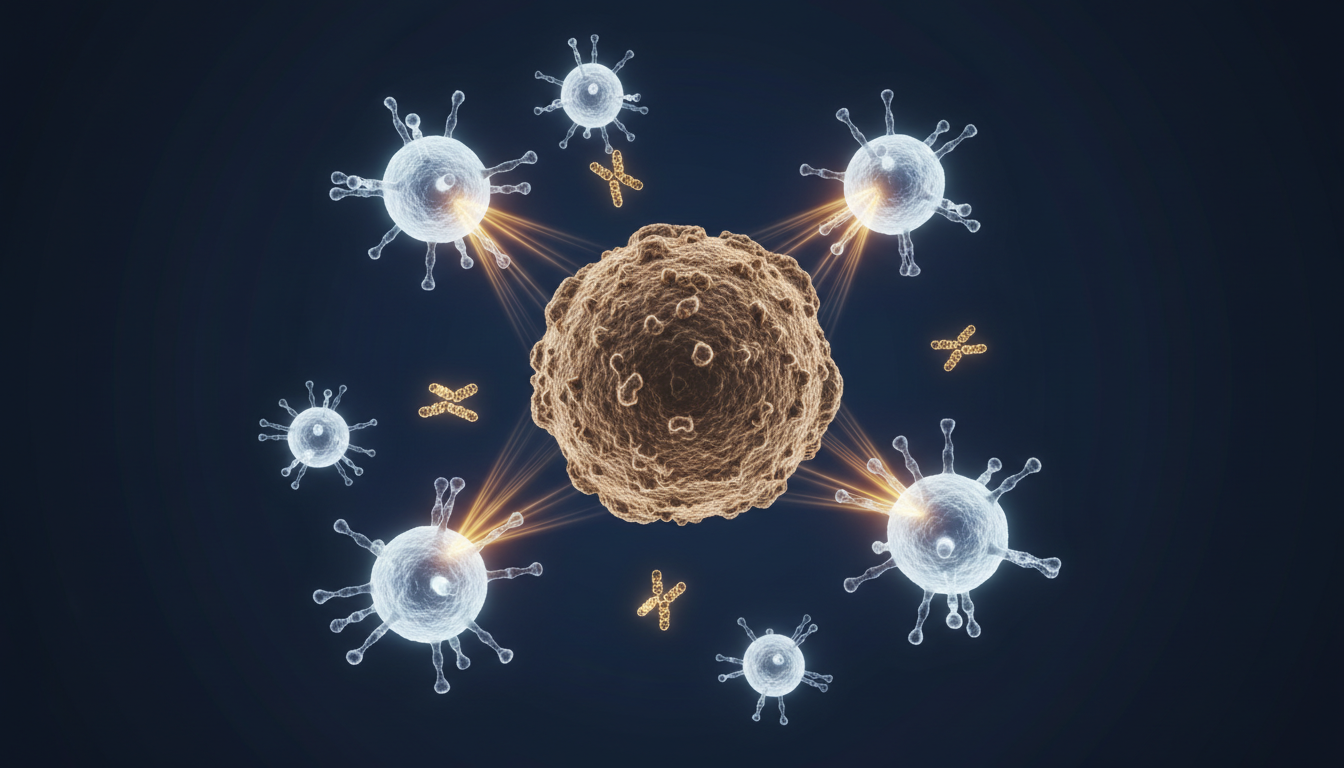
The immune system is built to find and destroy abnormal cells, including cancer cells. Cancers survive by hiding from it and by switching it off. Immunotherapy releases the immune system to do its job again, and it has changed cancer care more than any other treatment of the past 20 years. In 2018, James Allison of the United States and Tasuku Honjo of Japan received the Nobel Prize for the discoveries that made it possible. This article explains how the main types of immunotherapy work, who benefits, the side effects to watch for, and what can help or hurt the response.
Checkpoint Inhibitors: Releasing the Brakes
T cells, the immune system’s killer cells, carry built-in brakes called checkpoints, which normally stop them from attacking the body’s own tissues. The main ones are PD-1, CTLA-4 and LAG-3. Many cancers press on these brakes, for example by covering themselves with a protein called PD-L1. Checkpoint inhibitors are antibodies that block the brakes, so the T cells can attack again.
Common examples are pembrolizumab (Keytruda) and nivolumab (Opdivo), which block PD-1; ipilimumab (Yervoy), which blocks CTLA-4; and relatlimab, which blocks LAG-3. China has developed its own PD-1 drugs, including toripalimab, sintilimab and tislelizumab, and ivonescimab, which blocks PD-1 and the blood-vessel signal VEGF at the same time and has outperformed pembrolizumab in lung cancer. See our article on lung cancer treatment.
When these drugs work, the effect can last for years. In 2011, median survival for metastatic melanoma was about six and a half months. In the CheckMate 067 trial of 945 patients, the combination of nivolumab and ipilimumab produced a median overall survival of 71.9 months, and 52 percent of patients were alive and free of death from melanoma at 10 years.1
Who Benefits: The Tests That Predict Response
PD-L1. Tumors that carry more PD-L1 generally respond better, and some approvals require a minimum level.
MSI-high or mismatch repair deficiency. Tumors that cannot repair DNA mistakes carry many mutations that the immune system can recognize. In a landmark study of rectal cancer with this defect, every one of the first 12 patients treated with the checkpoint inhibitor dostarlimab had a complete clinical response and avoided surgery and radiation.2
Tumor mutational burden. A high number of mutations also predicts a better response. All three are measured with tumor testing. See our article on tumor DNA and RNA sequencing.
Cell Therapies: CAR-T and TIL
CAR-T cells. A patient’s own T cells are collected, engineered in the laboratory to recognize a target on the cancer, multiplied and returned. CAR-T is now standard in several lymphomas, leukemias and multiple myeloma, and is being studied in brain tumors. See our articles on lymphoma and glioblastoma.
TIL therapy. Tumor-infiltrating lymphocytes are immune cells that have already found their way into the tumor. They are taken from a removed tumor, multiplied into the billions and returned. In a trial led by the Netherlands Cancer Institute of 168 patients with advanced melanoma, TIL therapy more than doubled the time before the cancer progressed, 7.2 months compared with 3.1 months with ipilimumab, and the cancer shrank in 49 percent of patients, compared with 21 percent.3
Bispecific antibodies. These drugs link a T cell directly to a cancer cell. They are now used in lymphoma, myeloma and small cell lung cancer.
Personalized Cancer Vaccines
A personalized mRNA vaccine is designed from the unique mutations in a patient’s own tumor, teaching the immune system to recognize that specific cancer. In the INTerpath-001 trial of 1,137 patients whose melanoma had been removed, adding the personalized vaccine intismeran to pembrolizumab reduced the risk of the cancer returning or death by 42 percent compared with pembrolizumab alone, and by 58 percent after the vaccine course was completed. The detailed results are being presented this month at the European Society for Medical Oncology Congress, and overall survival is still being measured.4 See our article on melanoma treatment.
Other vaccines use the patient’s own dendritic cells, the immune system’s teachers, loaded with proteins from the tumor. Dendritic cell vaccines and natural killer (NK) cells are covered in depth in our book.
Side Effects to Watch For
Because immunotherapy releases the immune system, it can also attack healthy organs. The most common problems are diarrhea from inflammation of the bowel, an underactive or overactive thyroid, skin rash, and inflammation of the lungs or liver. Less often, it affects the pituitary gland or causes type 1 diabetes. These effects can appear months after treatment starts, and most are manageable when caught early, so any new symptom should be reported promptly.
What Can Help or Hurt the Response
Antibiotics. Researchers at Gustave Roussy in France found that patients who took antibiotics around the start of immunotherapy did worse, because antibiotics disrupt the gut bacteria that help the immune system respond.5
Dietary fiber. In a study of 128 patients with melanoma at MD Anderson Cancer Center, those who ate enough dietary fiber lived longer without their cancer progressing on immunotherapy. Over-the-counter probiotic supplements did not help.6
Fecal microbiota transplant. In a Canadian trial, 20 patients with advanced melanoma received gut bacteria from healthy donors before starting immunotherapy, and the cancer shrank in 65 percent.7
Vitamin D. In a Polish study of 200 patients with advanced melanoma on immunotherapy, those with normal vitamin D levels, either naturally or with supplements, responded more often, 56 percent compared with 36 percent, and their cancer was controlled about twice as long.8 See our article on vitamin D and cancer.
Morning infusions: not proven. In early 2026, a widely reported Chinese trial claimed that giving immunotherapy before 3 p.m. nearly doubled survival in lung cancer. The journal Nature Medicine retracted the study on June 24, 2026, after finding serious irregularities.9 Whether time of day matters is still unknown, and new randomized trials are under way.
How Cancer Expert MD Helps
Cancer Expert MD specializes in education and consultation for people with Stage IV and metastatic cancer. Our guide to what to do when chemotherapy stops working explains re-testing and the next steps, and our book, The New Reality of Cancer, covers immunotherapy of every type, including CAR-T, NK cells and cancer vaccines.
Frequently Asked Questions
What is immunotherapy?
Treatment that helps the immune system find and destroy cancer, by releasing its brakes, engineering immune cells to attack the cancer, or teaching it to recognize the tumor with a vaccine.
Does immunotherapy work for every cancer?
No. It works best in melanoma, lung, kidney and bladder cancer, and in any cancer that is MSI-high or has many mutations. Tumor testing for PD-L1, MSI and mutational burden helps predict who will respond.
What are the main side effects?
Inflammation of healthy organs, most often the bowel, thyroid, skin, lungs and liver. These can appear months after starting treatment and are usually manageable when caught early.
Do antibiotics affect immunotherapy?
Research from Gustave Roussy in France found worse results in patients who took antibiotics around the start of immunotherapy, because antibiotics disturb the gut bacteria that support the immune response.

About the author. Dr. Silver, MD, graduated from Temple University School of Medicine, trained as an interventional cardiologist, and has practiced medicine for nearly fifty years. A lymphoma survivor of about twenty-five years, he is co-author, with Dr. Lindmeier, DHSc, of The New Reality of Cancer: The Science of Recovery. Read more about Dr. Silver, MD.
Research by Dr. Lindmeier, DHSc, cancer educator and co-author of The New Reality of Cancer.
More articles on cancer treatments and all articles.
References
- Wolchok JD, Chiarion-Sileni V, Rutkowski P, et al. Final, 10-year outcomes with nivolumab plus ipilimumab in advanced melanoma. New England Journal of Medicine. 2025;392(1):11–22.
- Cercek A, Lumish M, Sinopoli J, et al. PD-1 blockade in mismatch repair–deficient, locally advanced rectal cancer. New England Journal of Medicine. 2022;386(25):2363–2376.
- Rohaan MW, Borch TH, van den Berg JH, et al. Tumor-infiltrating lymphocyte therapy or ipilimumab in advanced melanoma. New England Journal of Medicine. 2022;387(23):2113–2125.
- Intismeran autogene plus pembrolizumab versus pembrolizumab alone in completely resected stage IIB–IV melanoma: phase 3 INTerpath-001 trial. European Society for Medical Oncology (ESMO) Congress 2026, Presidential Symposium.
- Routy B, Le Chatelier E, Derosa L, et al. Gut microbiome influences efficacy of PD-1–based immunotherapy against epithelial tumors. Science. 2018;359(6371):91–97.
- Spencer CN, McQuade JL, Gopalakrishnan V, et al. Dietary fiber and probiotics influence the gut microbiome and melanoma immunotherapy response. Science. 2021;374(6575):1632–1640.
- Routy B, Lenehan JG, Miller WH Jr, et al. Fecal microbiota transplantation plus anti-PD-1 immunotherapy in advanced melanoma: a phase I trial. Nature Medicine. 2023;29(8):2121–2132.
- Galus Ł, Michalak M, Lorenz M, et al. Vitamin D supplementation increases objective response rate and prolongs progression-free time in patients with advanced melanoma undergoing anti–PD-1 therapy. Cancer. 2023;129(13):2047–2055.
- Retraction note: Time-of-day immunochemotherapy in non-small cell lung cancer: a randomized phase 3 trial. Nature Medicine. June 24, 2026.
This article is for education only. It is not medical advice and does not diagnose or treat any condition. Cancer Expert MD has no financial relationship with any laboratory, drug maker, supplement company, clinic or hospital.
Leave a Reply