
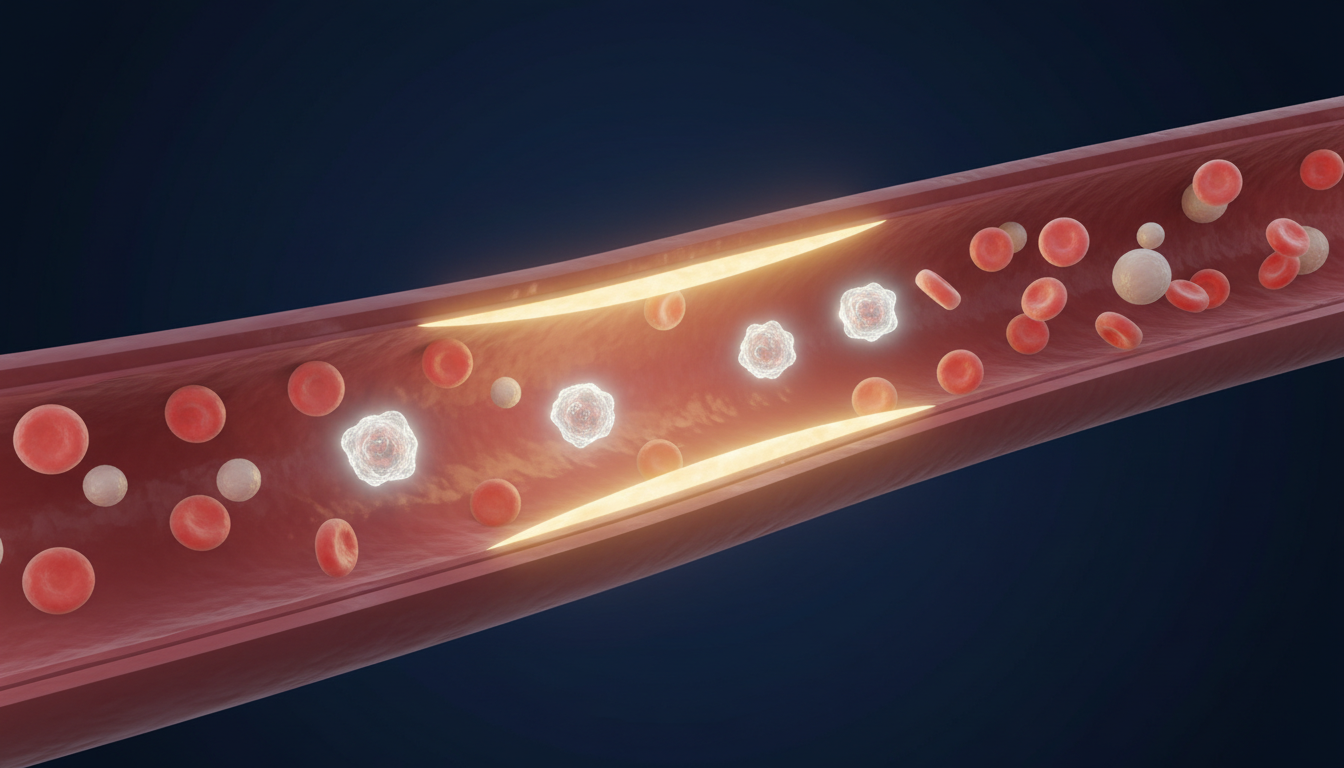
Most cancer deaths are caused not by the original tumor but by cancer that has spread to other organs, a process called metastasis. Yet spread is not inevitable, and it is not random. Cancer cells must leave the tumor, survive in the bloodstream, settle in a new organ, and wake up and grow there. Each step offers a chance to stop them. This article explains how cancer spreads and what clinical trials show can lower the risk.
Part of our guide: Stage 4 Cancer: Options, Testing and the Latest Research
How Cancer Spreads
Cancer cells break away from the tumor and travel in the blood as circulating tumor cells. Most die there, but some hide inside clumps of platelets that protect them. The survivors can settle in the bones, liver, lungs or brain and lie dormant for months or years. Inflammation can wake them up. In a study in Science, inflammation in the lungs of mice caused white blood cells to release sticky webs, called neutrophil extracellular traps, that awakened dormant breast cancer cells and made them grow.1 This is why controlling inflammation, stress and the conditions around cancer cells matters as much as attacking the cells themselves.
Exercise
The CHALLENGE trial, published in the New England Journal of Medicine in 2025, enrolled 889 people with stage II or III colon cancer who had finished chemotherapy. Those given a three-year coached exercise program had a 28 percent lower risk of their cancer returning, a new cancer, or death, and 90.3 percent were alive after eight years, compared with 83.2 percent of those who received only health-education materials.2 It is the first large randomized trial to prove that exercise prevents cancer from coming back.
Aspirin for Certain Colorectal Cancers
The ALASCCA trial, run across Sweden, Denmark, Finland and Norway, tested low-dose aspirin, 160 mg a day for three years after surgery, in people whose colorectal cancer carried a change in the PI3K growth pathway. Aspirin cut the rate of cancer returning roughly in half.3 This shows how testing the tumor for its driver pathways can identify who benefits from an inexpensive old drug. See our article on cancer driver pathways.
Worried about cancer spreading? We can help.
With nearly 50 years of experience, Dr. Silver, MD, explains conventional and integrative options, so you can make informed decisions with your treating team.
REQUEST A CONSULTATIONThe Critical Window Around Surgery
Surgery is essential, but the days around it are a vulnerable time. Handling the tumor releases cancer cells into the blood, while stress hormones and inflammation from the operation weaken the immune system and help those cells settle. Researchers at Tel Aviv University in Israel gave the blood pressure drug propranolol, which blocks stress hormones, together with the anti-inflammatory drug etodolac, for a few weeks around surgery. In women with breast cancer, the combination reduced markers of spread in the removed tumors,4 and in a trial in colorectal cancer, patients who received it had fewer recurrences over the following years.5
Cimetidine. In a Japanese randomized trial, people with colorectal cancer who took the inexpensive heartburn drug cimetidine for one year after surgery had a ten-year survival of 84.6 percent, compared with 49.8 percent with standard care alone. Cimetidine blocks a molecule cancer cells use to stick to blood vessel walls when they spread.6
Protecting the Bones
The bones are a common landing place for breast and prostate cancer. A worldwide analysis of trials including more than 18,000 women found that in postmenopausal women with early breast cancer, bone-strengthening drugs called bisphosphonates reduced spread to the bones by 28 percent and deaths from breast cancer by 18 percent.7
Vitamin D
In the Japanese AMATERASU trial of people with digestive tract cancers, vitamin D after surgery did not improve relapse-free survival in the trial as a whole, but people whose tumors carried a particular p53 pattern did have fewer relapses.8 See our article on vitamin D.
Watching for Early Return
Blood tests can now find traces of cancer long before scans can. Tumor DNA in the blood and circulating tumor cells can reveal cancer that remains after treatment, allowing action while the amount of cancer is smallest. See our articles on ctDNA liquid biopsy, the circulating tumor cell test, why cancer comes back and our guide to repurposed drugs.
How Cancer Expert MD Helps
Cancer Expert MD provides education and consultation for people with every type and stage of cancer, and specializes in Stage IV and metastatic cancer. Our book, The New Reality of Cancer, has a full chapter on preventing metastasis, covering each step of spread and the drugs, natural compounds and lifestyle measures studied to block it.
Frequently Asked Questions
Can exercise prevent cancer from coming back?
In the CHALLENGE trial of colon cancer, a three-year coached exercise program lowered the risk of the cancer returning, a new cancer or death by 28 percent and improved survival.
Does aspirin prevent cancer recurrence?
In the Nordic ALASCCA trial, low-dose aspirin roughly halved recurrence in colorectal cancers with a PI3K pathway change. Testing the tumor shows who is likely to benefit.
Why is the time around surgery important?
Surgery releases cancer cells into the blood while stress hormones and inflammation weaken the immune system. Israeli trials of propranolol and etodolac around surgery reduced markers of spread.
Can cancer that has spread be detected early?
Blood tests for tumor DNA and circulating tumor cells can find traces of cancer months before scans.

About the author. Dr. Silver, MD, graduated from Temple University School of Medicine, completed fellowship training in cardiology, and has practiced medicine for nearly fifty years. A lymphoma survivor of about twenty-five years, he is co-author, with Dr. Lindmeier, DHSc, of The New Reality of Cancer: The Science of Recovery. Read more about Dr. Silver, MD.
Research by Dr. Lindmeier, DHSc, cancer educator and co-author of The New Reality of Cancer.
This article is for general education only and is not individual medical advice. Always consult your own doctor before making any changes to your care.
© 2026 Lovely LYF LLC. All rights reserved. This article draws on the research in The New Reality of Cancer and may not be copied, republished or distributed without written permission.
For more in-depth information on this topic and many others, get our book, The New Reality of Cancer: The Science of Recovery.
Explore our guides: Stage 4 Cancer Options · Advanced Cancer Testing · Integrative Cancer Treatment Options · Natural Compounds and Cancer · Repurposed Drugs for Cancer · Cancer Treatment by Type
More articles on all topics.
References
- Albrengues J, Shields MA, Ng D, et al. Neutrophil extracellular traps produced during inflammation awaken dormant cancer cells in mice. Science. 2018;361(6409):eaao4227.
- Courneya KS, Vardy JL, O’Callaghan CJ, et al. Structured exercise after adjuvant chemotherapy for colon cancer. New England Journal of Medicine. 2025.
- Martling A, et al. Low-dose aspirin for PI3K-altered localized colorectal cancer (ALASCCA). New England Journal of Medicine. 2025.
- Shaashua L, Shabat-Simon M, Haldar R, et al. Perioperative COX-2 and β-adrenergic blockade improves metastatic biomarkers in breast cancer patients in a phase-II randomized trial. Clinical Cancer Research. 2017;23(16):4651–4661.
- Ricon-Becker I, Haldar R, Simon MS, et al. Effect of perioperative COX-2 and beta-adrenergic inhibition on 5-year disease-free survival in colorectal cancer: a pilot randomized controlled Colorectal Metastasis Prevention Trial (COMPIT). European Journal of Surgical Oncology. 2023.
- Matsumoto S, Imaeda Y, Umemoto S, Kobayashi K, Suzuki H, Okamoto T. Cimetidine increases survival of colorectal cancer patients with high levels of sialyl Lewis-X and sialyl Lewis-A epitope expression on tumour cells. British Journal of Cancer. 2002;86(2):161–167.
- Early Breast Cancer Trialists’ Collaborative Group (EBCTCG). Adjuvant bisphosphonate treatment in early breast cancer: meta-analyses of individual patient data from randomised trials. The Lancet. 2015;386(10001):1353–1361.
- Urashima M, Ohdaira H, Akutsu T, et al. Effect of vitamin D supplementation on relapse-free survival among patients with digestive tract cancers: the AMATERASU randomized clinical trial. JAMA. 2019;321(14):1361–1369.
This article is for education only. It is not medical advice and does not diagnose or treat any condition. Cancer Expert MD has no financial relationship with any laboratory, drug maker, supplement company, clinic or hospital.
Leave a Reply