
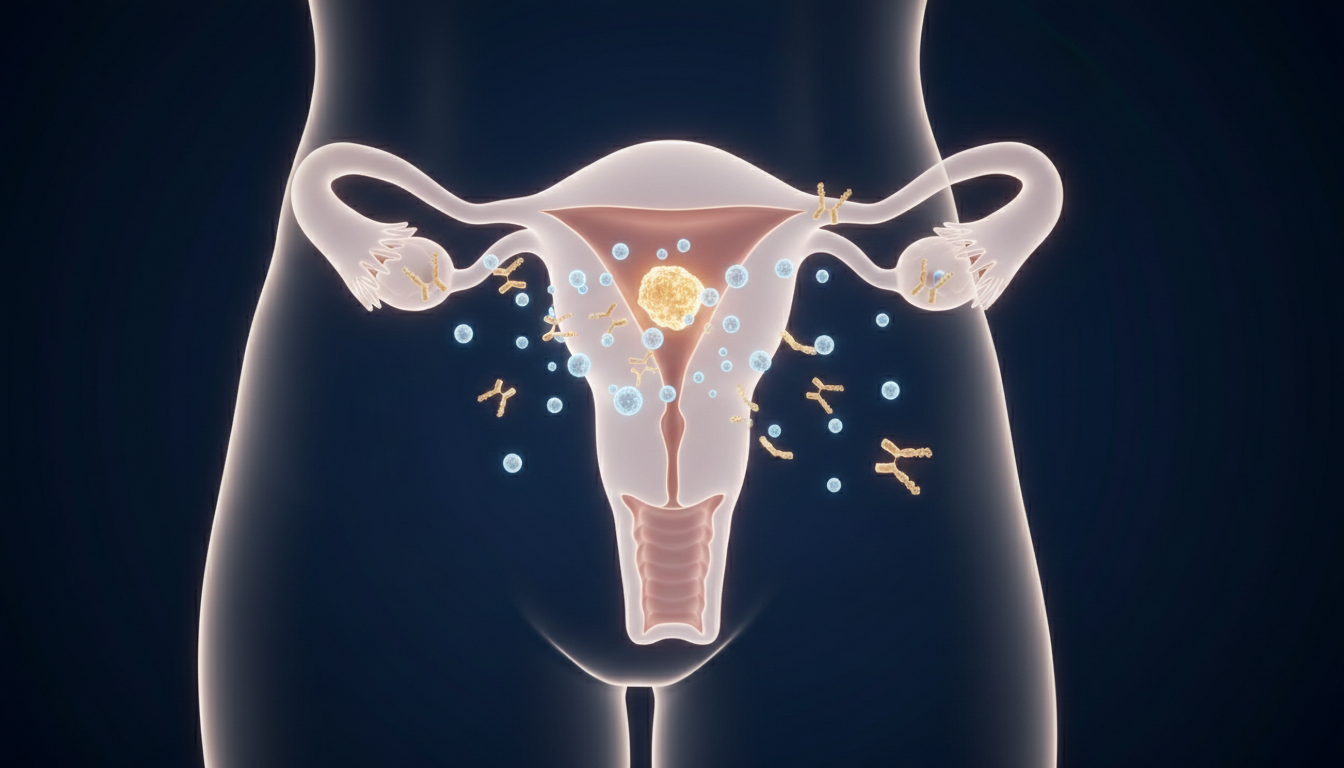
Uterine cancer, most often endometrial cancer, which starts in the lining of the uterus, is the most common gynecologic cancer in many countries, and it is becoming more common. Because it usually causes bleeding early, most cases are found at an early stage and cured with surgery. For advanced or recurrent disease, adding immunotherapy to chemotherapy has transformed the outlook. This article explains the warning signs, the tumor tests that now guide treatment, the newest results, and the integrative evidence.
Warning Signs and Risk
Any bleeding after menopause should be checked, as should unusually heavy or irregular bleeding before it. Excess weight is the biggest risk factor, because fat tissue produces estrogen, which stimulates the uterine lining. Diabetes, the breast cancer drug tamoxifen, and an inherited condition called Lynch syndrome also raise the risk.
The Tumor Tests That Guide Treatment
Every uterine cancer can now be sorted into one of four molecular groups, and the group often matters more than the stage:
POLE-mutated: an excellent outlook, sometimes needing less treatment. Mismatch repair deficient (MMRd): responds strongly to immunotherapy, and should prompt testing for Lynch syndrome. p53-abnormal: the most aggressive group, which benefits most from chemotherapy. No specific molecular profile: often hormone-sensitive.
In the Dutch-led PORTEC-3 trial, when researchers in Leiden sorted women by these groups, the benefit of adding chemotherapy to radiation was concentrated in those with p53-abnormal tumors.1 European trials now assign treatment by molecular group. Testing for HER2 is also important in the serous type. See our article on tumor sequencing.
2026: Immunotherapy With Chemotherapy
In the RUBY trial of 494 women with advanced or recurrent endometrial cancer, led by Mansoor Mirza of Rigshospitalet in Copenhagen, the immunotherapy drug dostarlimab was added to carboplatin and paclitaxel chemotherapy.2 Four-year results, presented in 2026, were striking for women with mismatch repair deficient tumors: 72.8 percent were alive at four years, compared with 40.3 percent with chemotherapy alone, a 66 percent reduction in the risk of death. Only four of these women had their cancer progress in the last two and a half years of follow-up, and researchers estimate that about half may be cured.3 Women with other tumor types also lived about seven months longer.
Similar trials with pembrolizumab and durvalumab confirmed the benefit, and immunotherapy with chemotherapy is now the standard first treatment for advanced uterine cancer. See our article on how immunotherapy works.
Lynch Syndrome
About one in 30 women with endometrial cancer has Lynch syndrome, an inherited defect in DNA repair that also raises the risk of colon and other cancers. Finding it protects the whole family, because relatives can be tested and screened early. See our article on colon cancer.
Integrative Evidence
Weight and insulin. Because excess weight and high insulin drive this cancer, metabolic approaches are especially relevant. In a randomized trial of 45 women with ovarian or endometrial cancer, 12 weeks of a ketogenic diet reduced abdominal fat and fasting insulin compared with a standard recommended diet.4 See our articles on the ketogenic diet and metformin.
Preserving fertility. For selected younger women with very early, low-grade cancer, progestin hormone treatment, often through a hormone-releasing IUD, can control the cancer and preserve fertility.
How Cancer Expert MD Helps
Cancer Expert MD provides education and consultation for people with every type and stage of cancer, and specializes in Stage IV and metastatic cancer. Our guide to what to do when chemotherapy stops working explains re-testing and the next steps, and our book, The New Reality of Cancer, covers testing and treatment across all cancers. See also our article on ovarian cancer.
Frequently Asked Questions
What is the main warning sign of uterine cancer?
Bleeding after menopause, which should always be checked.
Why does molecular testing matter?
The four molecular groups predict outcome and guide treatment. Mismatch repair deficient tumors respond strongly to immunotherapy, and p53-abnormal tumors benefit most from chemotherapy.
What did the RUBY trial show?
In women with mismatch repair deficient advanced uterine cancer, adding dostarlimab to chemotherapy raised four-year survival to 72.8 percent from 40.3 percent, and researchers estimate about half may be cured.
What is Lynch syndrome?
An inherited DNA repair defect that raises the risk of uterine, colon and other cancers. Relatives can be tested and screened early.

About the author. Dr. Silver, MD, graduated from Temple University School of Medicine, trained as an interventional cardiologist, and has practiced medicine for nearly fifty years. A lymphoma survivor of about twenty-five years, he is co-author, with Dr. Lindmeier, DHSc, of The New Reality of Cancer: The Science of Recovery. Read more about Dr. Silver, MD.
Research by Dr. Lindmeier, DHSc, cancer educator and co-author of The New Reality of Cancer.
This article is for general education only and is not individual medical advice. Always consult your own doctor before making any changes to your care.
© 2026 Cancer Expert MD, Dr. Silver, MD, and Dr. Lindmeier, DHSc. All rights reserved. This article draws on the research in The New Reality of Cancer and may not be copied, republished or distributed without written permission.
For more in-depth information on this topic and many others, get our book, The New Reality of Cancer: The Science of Recovery.
More articles on cancer types and all articles.
References
- León-Castillo A, de Boer SM, Powell ME, et al. Molecular classification of the PORTEC-3 trial for high-risk endometrial cancer: impact on prognosis and benefit from adjuvant therapy. Journal of Clinical Oncology. 2020;38(29):3388–3397.
- Mirza MR, Chase DM, Slomovitz BM, et al. Dostarlimab for primary advanced or recurrent endometrial cancer (RUBY). New England Journal of Medicine. 2023;388(23):2145–2158.
- Powell MA, et al. Four-year survival outcomes with dostarlimab plus chemotherapy in mismatch repair deficient/microsatellite instability-high primary advanced or recurrent endometrial cancer in the RUBY trial. Gynecologic Oncology. 2026.
- Cohen CW, Fontaine KR, Arend RC, et al. A ketogenic diet reduces central obesity and serum insulin in women with ovarian or endometrial cancer. Journal of Nutrition. 2018;148(8):1253–1260.
This article is for education only. It is not medical advice and does not diagnose or treat any condition. Cancer Expert MD has no financial relationship with any laboratory, drug maker, supplement company, clinic or hospital.
Leave a Reply